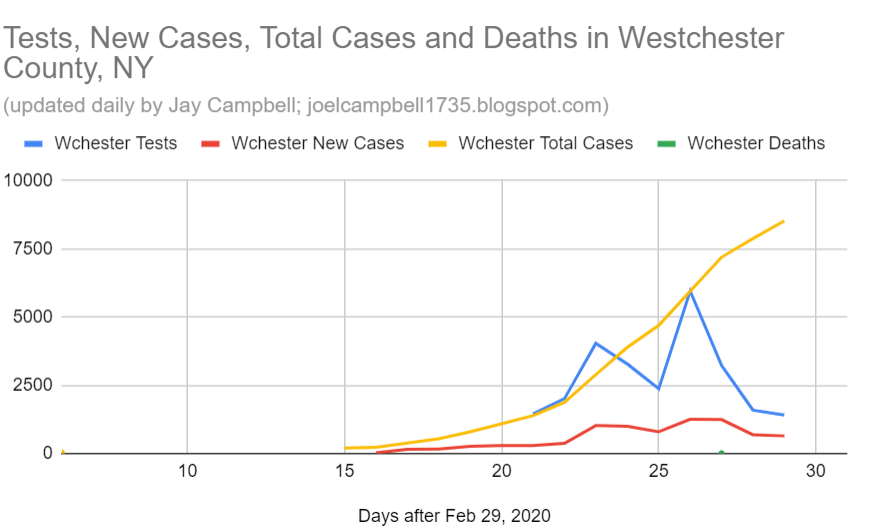
Historical Trend of Tests, New Cases, Total Cases in Westchester. The current death rate is 0.2% but death reporting may be lagging the reporting of new cases. (19 deaths/9326 total confirmed cases).
Historical Trend of New Cases in Westchester vs NYC vs Nassau County. New Cases are presumed to peak about 7-14 days after the number of 'new infections' peak. Deaths will peak 7-14 days after New Cases peaks.
Total Cases in Westchester vs Yonkers. Note that the cases for Yonkers are made public several days after the data is obtained by NYS. The delayed reporting is due to some HIPAA requirements. Despite the small bar, Yonkers has the most cases of any municipality in Westchester.
Joel Campbell was born in the shadow of Newark Mountain as America was coming to life. His long lifetime overlapped those of Washington, Jefferson, and Adams. Today, he has more than 300,000 descendants. All original content ©2013-2024 Jay Campbell. No portions can be copied to any other publicly accessible media, print or electronic, without permission of the author.
Tuesday, March 31, 2020
Monday, March 30, 2020
March 30 - COVID-19 in Westchester County
Is Social Distancing Working?
I have been following the Kinsa Health Maps healthweather.us to give me some insight into the COVID-19 pandemic spread. Here is their illness trend for Westchester County.
Go here https://healthweather.us/ to get the full explanation, but here is my brief interpretation.
Kinsa has internet-connected thermometers in homes, schools, clinics across the US. Kinsa collects this data in real time. "Fevers" are assumed to be associated with ILI (Influenza-Like Illness). It plots the incidence of illness along side their models of typical seasonal ILI trends for differenct geographical locations.
The trend for Westchester shows an anomaly starting about March 1. This is right about when the first case in New Rochelle was reported. On about March 15, when the social distancing started, the trend reversed.
The US trend is even more astounding. When social distancing started, the incidence of illness decreased. It has even dropped below the expected normal seasonal flu incidence. The unintended consequence is that we may be saving lives that would have died from the normal flu!
CAUTION!
In Dr. Raoult's study of 80 SARS-CoV-2 positive patients, only 15% had a fever!! (See previous blog) Does the Kinsa data undercount COVID-19 cases because of this? Perhaps Raoult's patients were in a later stage of the disease and their fevers had passed? OR, more sinister, does this virus sneak around the immune system and not trigger an immune response, evidenced by lack of fever? This would explain the large number of asymptomatic infectees and the number of patients still testing positive weeks after infection.
Sunday, March 29, 2020
March 29 - COVID-19 In Westchester County, NY
I have decided to use this venue as the repository of my COVID-19 musings. Pardon the departure from the Joel Campbell Story.
Sunday, March 29, 2020
I am currently living in Westchester County, NY about one mile outside of the original 1-mile-radius "quarantine" zone that centered on the Young Israel Synagogue in New Rochelle, the first COVID-19 cluster on the East Coast. By March 10, Westchester residents were starting to restrict their movements based on what was happening in New Rochelle and by March 13 the semi-panic had set in (empty store shelves). Over the next 2 weeks, Westchester grew to about 1% of the population confirmed positive. It still has twice the cases-per-capita vs. New York City that borders it on the south. If Westchester were a state, it would be second on the list of most cases following the state of NY (Update: NJ passed Westchester in number of cases today).
The real number of infected residents is still a mystery as testing is rationed - predominantly to the hospitalized population - with 30-45% of the tests coming back positive. I have published the county public numbers here (www.bit.ly/COVID-Westchester), but there are many problems with this data too numerous to talk about here, so don't use it to jump to conclusions. Westchester is too late to "identify and isolate." I hope, where ever you are, it is not too late, but the existence of so many asymptomatic spreaders may leave you with the same fate as Westchester. Be Well.
Sunday, March 29, 2020
I am currently living in Westchester County, NY about one mile outside of the original 1-mile-radius "quarantine" zone that centered on the Young Israel Synagogue in New Rochelle, the first COVID-19 cluster on the East Coast. By March 10, Westchester residents were starting to restrict their movements based on what was happening in New Rochelle and by March 13 the semi-panic had set in (empty store shelves). Over the next 2 weeks, Westchester grew to about 1% of the population confirmed positive. It still has twice the cases-per-capita vs. New York City that borders it on the south. If Westchester were a state, it would be second on the list of most cases following the state of NY (Update: NJ passed Westchester in number of cases today).
The real number of infected residents is still a mystery as testing is rationed - predominantly to the hospitalized population - with 30-45% of the tests coming back positive. I have published the county public numbers here (www.bit.ly/COVID-Westchester), but there are many problems with this data too numerous to talk about here, so don't use it to jump to conclusions. Westchester is too late to "identify and isolate." I hope, where ever you are, it is not too late, but the existence of so many asymptomatic spreaders may leave you with the same fate as Westchester. Be Well.
Saturday, March 28, 2020
March 28 - COVID in Westchester County, NY
Day 13 of National 15 days to Slow the Spread. It may be slowing, but unfortunately there is no way to measure in real time.
Latest on hydroxychloroquine:
Dr. Zelenko is treating the patients in Kiryas Joel and Monsey. It appears he is treating prophylactically. He says 669 patients have been treated, but there is no where close to that number testing positive in Rockland County.
https://www.thelakewoodscoop.com/news/2020/03/coronavirus-letter-from-dr-zelenko-to-israel-ministry-of-health-and-president-trump.html
Dr. Raoult has treated 80 more patients: https://www.mediterranee-infection.com/wp-content/uploads/2020/03/COVID-IHU-2-1.pdf
Here is link to his earlier paper: https://www.mediterranee-infection.com/wp-content/uploads/2020/03/Hydroxychloroquine_final_DOI_IJAA.pdf
---------------------------------------
One more interesting thing......I don't put a lot of faith in these numbers where the denominator is unknown, but it is encouraging that the death rate in Westchester is only 0.1%. 10 deaths in 7,187 cases. [It is likely that the death reporting number is lagging the reporting of new cases.]
---------------------------------------
The March 28 numbers for Westchester include 688 new cases bringing the total to 7875 or about 8 per 1000. Westchester still has more cases per capita than any county in the country. 1588 tests were performed in Westchester, 43% were positive, meaning testing is still rationed? The trend in new cases over the last four days is encouraging: 1253, 1243, 688. Unfortunately, I think these numbers are not a true picture as the numbers correlate with the number of tests done. For some reason the number of tests performed is dropping. Is that just working off a backlog? Or is there a decrease in demand? or is there a rationing of tests to counties that have more need, like NYC? If you do fewer tests, there are fewer new cases. Do zero tests, and you will get zero new cases. Here is a chart I threw together. I wish I had more of the data. When I find it, I will add it. The chart is updated daily. www.bit.ly/COVID-Westchester These google charts do not appear to work on Apple Phones or Safari.
----------------------
Abbotts 5 minute test using the ID NOW instrument. https://www.alere.com/en/home/product-details/id-now.html
https://www.abbott.com/corpnewsroom/product-and-innovation/detect-covid-19-in-as-little-as-5-minutes.html
Thanks to Alton Johnson for these links.
Latest on hydroxychloroquine:
Dr. Zelenko is treating the patients in Kiryas Joel and Monsey. It appears he is treating prophylactically. He says 669 patients have been treated, but there is no where close to that number testing positive in Rockland County.
https://www.thelakewoodscoop.com/news/2020/03/coronavirus-letter-from-dr-zelenko-to-israel-ministry-of-health-and-president-trump.html
Dr. Raoult has treated 80 more patients: https://www.mediterranee-infection.com/wp-content/uploads/2020/03/COVID-IHU-2-1.pdf
Here is link to his earlier paper: https://www.mediterranee-infection.com/wp-content/uploads/2020/03/Hydroxychloroquine_final_DOI_IJAA.pdf
---------------------------------------
One more interesting thing......I don't put a lot of faith in these numbers where the denominator is unknown, but it is encouraging that the death rate in Westchester is only 0.1%. 10 deaths in 7,187 cases. [It is likely that the death reporting number is lagging the reporting of new cases.]
---------------------------------------
The March 28 numbers for Westchester include 688 new cases bringing the total to 7875 or about 8 per 1000. Westchester still has more cases per capita than any county in the country. 1588 tests were performed in Westchester, 43% were positive, meaning testing is still rationed? The trend in new cases over the last four days is encouraging: 1253, 1243, 688. Unfortunately, I think these numbers are not a true picture as the numbers correlate with the number of tests done. For some reason the number of tests performed is dropping. Is that just working off a backlog? Or is there a decrease in demand? or is there a rationing of tests to counties that have more need, like NYC? If you do fewer tests, there are fewer new cases. Do zero tests, and you will get zero new cases. Here is a chart I threw together. I wish I had more of the data. When I find it, I will add it. The chart is updated daily. www.bit.ly/COVID-Westchester These google charts do not appear to work on Apple Phones or Safari.
----------------------
Abbotts 5 minute test using the ID NOW instrument. https://www.alere.com/en/home/product-details/id-now.html
https://www.abbott.com/corpnewsroom/product-and-innovation/detect-covid-19-in-as-little-as-5-minutes.html
Thanks to Alton Johnson for these links.
Friday, March 27, 2020
March 27 - COVID in Westchester County, NY
Friday, March 27
Are we victims of our own success?
There has been a lot of debate over the worldwide and local response to the COVID-19 pandemic. It got me thinking, what if the SARS-CoV-2 virus had appeared 20 years ago? What would have been different? Is it possible we would not have even known it was happening? Perhaps we would have commented after-the-fact that it had been a tough flu season? Or maybe it would be closer to the 1918 pandemic -- infecting a third of the planet and leaving 675,000 or about 1% of Americans dead?
Twenty years ago, we would not have been able to ID the virus and develop a test for it in such a short time. Twenty years ago the automated RT-PCR instruments that can kick out 100s of tests per day did not exist. Rapid DNA testing technology was in its infancy twenty years ago. In 2000 FamilyTreeDNA offered the first Direct-To-Consumer DNA testing. Today millions have purchased their genetic fingerprint for under $100.
A vaccine went into clinical trials a week ago. I have been out of the pharma industry for a few years, but I still know enough to say that is insanely fast. Not possible 20 years-ago.
Yesterday, RayBiotech offered its finger-prick test for SARS-CoV-2 IgG and IgM antibodies on its website. It is not FDA approved. Supposedly they have made over a million of these kits. The speed with which that was done is mind-blowing to me, but I am sure some people will complain about it. Twenty years ago, we would still be trying to identify what the antibodies were, let alone having a commercial test available.
Today we all know where Wuhan is. (or do we?) Twenty years ago news out of this region of China was limited. We complain about how information about the Chinese epidemic was surpressed, but twenty years ago, even if the info was not supressed, it would have been even longer in getting to us.
Twenty years ago, fewer people would have been able to work from home. The technology was primitive with fewer highspeed connections. The ability to conduct some business while isolated may save us from a total economic stoppage. There was no Zoom or Webex or GoToMeeting. I remember distinctly the technology I was using for a global virtual meeting on 9/11/2001.
The world population has grown 33% from six billion to eight billion in the last twenty years with disproportional growth in high density areas. The province of Hubei (where Wuhan is located) has 12 cities with populations over two million. This density certainly makes controlling epidemics more difficult today than 20 years ago.
What hasn't changed? Personal Hygiene? Cleanliness of Public Areas? On my recent visit to San Diego, I found most of the public restrooms closed. It appears that public restrooms attracted camps of homeless and could not be kept clean. (I caught the flu in SanDiego in January and needed a restroom quite badly. My Uber driver drove me from spot to spot, only to find them closed. ;-)) My experience in the NYC subway in the last ten years is not extensive enough to render a definitive opinion, but they do not appear to be getting cleaner. My gym provides handsanitizer & disinfectant spray, but I see few people using it. The check-in uses a keypad and fingerprint scanner which I have never seen cleaned.
What will the world's pandemic response be 20 years from now? It probably cannot even be imagined. My prediction is that face masks and ventilators will not be the biggest problem.
-----------------------------
Here are the latest numbers for Westchester and New York City. If you don't like numbers, you will find this tedious. If you like numbers that are easily interpreted, you will be frustrated. There are at least three problems with using the test results to estimate viral spread rate and extent of spread. 1) It appears testing is still being rationed. 2) Test results lag infection date by days or weeks and 3) even if testing were not rationed asymptomatic cases would not be detected.
The 3/27 numbers for Westchester include another 1243 new cases bringing the total to 7187 or about 7 per 1000. Westchester has more cases per capita than any county in the country. If Westchester were a state, it would rank #2 (after NY) in number of cases. It has almost double the cases per capita of NYC. 3227 tests were performed in Westchester so almost 40% were positive. That is much higher than the US average of about 15% which makes me think testing is still being rationed in Westchester and the total actual infections are underreported. www.bit.ly/COVID-Westchester
New York City in comparison had 4005 new cases from 6923 tests or 60%. Once again this tells me tests are being rationed and the total cases is underreported. NYC has 25398 total cases or 3 per 1000.
Both the NYC and Westchester numbers contain hot spots within those areas. Westchester is a big county stretching north from the Bronx over 30 miles. The southern third has the densest population, is closest to NYC, and is where the cases are concentrated. This area includes New Rochelle and Yonkers (where I am writing this note). The reporting of actual cases in these municipalities lags the county reports by several days due to a state policy of not making those numbers public until all test results have been reported to patients. The New Rochelle cluster included the first NY case and was spread to his family, work colleagues, and synagogue members.
Another county, Nassau, borders Queens on the east. It has 743 new positives out of 1411 tests bringing its total to 4657 or more than 3 in 1000.
Queens is a hotspot in NYC. Note that the 300 cases reported in the NYPD is a rate of 5 in 1000, higher than NYC but not out of the range for the NYC area.
-----------------------------
SD Biosensor https://www.henryschein.com/us-en/images/corporate/covid-19-rapid-test-qa.3.26.2020.pdf
Are we victims of our own success?
There has been a lot of debate over the worldwide and local response to the COVID-19 pandemic. It got me thinking, what if the SARS-CoV-2 virus had appeared 20 years ago? What would have been different? Is it possible we would not have even known it was happening? Perhaps we would have commented after-the-fact that it had been a tough flu season? Or maybe it would be closer to the 1918 pandemic -- infecting a third of the planet and leaving 675,000 or about 1% of Americans dead?
Twenty years ago, we would not have been able to ID the virus and develop a test for it in such a short time. Twenty years ago the automated RT-PCR instruments that can kick out 100s of tests per day did not exist. Rapid DNA testing technology was in its infancy twenty years ago. In 2000 FamilyTreeDNA offered the first Direct-To-Consumer DNA testing. Today millions have purchased their genetic fingerprint for under $100.
A vaccine went into clinical trials a week ago. I have been out of the pharma industry for a few years, but I still know enough to say that is insanely fast. Not possible 20 years-ago.
Yesterday, RayBiotech offered its finger-prick test for SARS-CoV-2 IgG and IgM antibodies on its website. It is not FDA approved. Supposedly they have made over a million of these kits. The speed with which that was done is mind-blowing to me, but I am sure some people will complain about it. Twenty years ago, we would still be trying to identify what the antibodies were, let alone having a commercial test available.
Today we all know where Wuhan is. (or do we?) Twenty years ago news out of this region of China was limited. We complain about how information about the Chinese epidemic was surpressed, but twenty years ago, even if the info was not supressed, it would have been even longer in getting to us.
Twenty years ago, fewer people would have been able to work from home. The technology was primitive with fewer highspeed connections. The ability to conduct some business while isolated may save us from a total economic stoppage. There was no Zoom or Webex or GoToMeeting. I remember distinctly the technology I was using for a global virtual meeting on 9/11/2001.
The world population has grown 33% from six billion to eight billion in the last twenty years with disproportional growth in high density areas. The province of Hubei (where Wuhan is located) has 12 cities with populations over two million. This density certainly makes controlling epidemics more difficult today than 20 years ago.
What hasn't changed? Personal Hygiene? Cleanliness of Public Areas? On my recent visit to San Diego, I found most of the public restrooms closed. It appears that public restrooms attracted camps of homeless and could not be kept clean. (I caught the flu in SanDiego in January and needed a restroom quite badly. My Uber driver drove me from spot to spot, only to find them closed. ;-)) My experience in the NYC subway in the last ten years is not extensive enough to render a definitive opinion, but they do not appear to be getting cleaner. My gym provides handsanitizer & disinfectant spray, but I see few people using it. The check-in uses a keypad and fingerprint scanner which I have never seen cleaned.
What will the world's pandemic response be 20 years from now? It probably cannot even be imagined. My prediction is that face masks and ventilators will not be the biggest problem.
-----------------------------
Here are the latest numbers for Westchester and New York City. If you don't like numbers, you will find this tedious. If you like numbers that are easily interpreted, you will be frustrated. There are at least three problems with using the test results to estimate viral spread rate and extent of spread. 1) It appears testing is still being rationed. 2) Test results lag infection date by days or weeks and 3) even if testing were not rationed asymptomatic cases would not be detected.
The 3/27 numbers for Westchester include another 1243 new cases bringing the total to 7187 or about 7 per 1000. Westchester has more cases per capita than any county in the country. If Westchester were a state, it would rank #2 (after NY) in number of cases. It has almost double the cases per capita of NYC. 3227 tests were performed in Westchester so almost 40% were positive. That is much higher than the US average of about 15% which makes me think testing is still being rationed in Westchester and the total actual infections are underreported. www.bit.ly/COVID-Westchester
New York City in comparison had 4005 new cases from 6923 tests or 60%. Once again this tells me tests are being rationed and the total cases is underreported. NYC has 25398 total cases or 3 per 1000.
Both the NYC and Westchester numbers contain hot spots within those areas. Westchester is a big county stretching north from the Bronx over 30 miles. The southern third has the densest population, is closest to NYC, and is where the cases are concentrated. This area includes New Rochelle and Yonkers (where I am writing this note). The reporting of actual cases in these municipalities lags the county reports by several days due to a state policy of not making those numbers public until all test results have been reported to patients. The New Rochelle cluster included the first NY case and was spread to his family, work colleagues, and synagogue members.
Another county, Nassau, borders Queens on the east. It has 743 new positives out of 1411 tests bringing its total to 4657 or more than 3 in 1000.
Queens is a hotspot in NYC. Note that the 300 cases reported in the NYPD is a rate of 5 in 1000, higher than NYC but not out of the range for the NYC area.
-----------------------------
SD Biosensor https://www.henryschein.com/us-en/images/corporate/covid-19-rapid-test-qa.3.26.2020.pdf
Sunday, October 20, 2019
The Andrew Campbell Project
The average number of matches for a submitter on AncestryDNA is about 50,000!
About 90% of those will be “distant” (meaning greater than 4 generations away) or about 45,000.
Of those 45,000, about 25% will be total mysteries. Most of the matches will have no surnames in common with you in the last five generations. Who are these people?
=====================
I will come back to that question, but first let me tell you about Andrew Campbell. Andrew was born in 1747. At the age of 28 he enlisted in the Minutemen of Hanover, Ulster, New York. In 1776 he enlisted in one of the New York Regiments of the Continental Army and served until the end of the war in 1783. He married Catharine Rumfield and had a child, John Rumfield Campbell, in 1785 in Marbletown, Ulster, New York. He lived most of his later days near Burlington, New Jersey, and fathered several other children. I have written a little about his military history (Journal of the Clan Campbell Society of NA) including his discharge at New Windsor.
More importantly, I have bumped into a couple descendants and active researchers of Andrew Campbell. Unfortunately, the ancestry of Andrew is still unknown. Because of his proximity to the Newark Mountain, New Jersey Campbells who were living in Hanover, NY where Andrew enlisted, and because he was in the same militia companies as they were, it seems that this connection is one to disprove. That could be done easily with YDNA (see this blog on my 8th cousin 1x removed), but Andrew has no living paternal descendant.
=========================
If Andrew was related to the Newark Mountain Campbells....say a cousin of Joel Campbell....that would make a living decendant about an 8th cousin to me (and you?). Theoretically, each of us have about a half million living 8th cousins (see https://isogg.org/wiki/Cousin_statistics). Some of my 10,000 "mystery matches" at AncestryDNA are 8th cousins. Could a descendant of Andrew be one of them?
======================
More about DNA... When DNA is passed from parents to child, half is from the mother and half is from the father. But what half? [It is possible (although extremely unlikely) that your sibling could have a totally different DNA signature. This could happen if you get the exact opposite half of your parents' DNA as your sibling. This is as likely as flipping a coin 3 billion times and getting heads all 3 billion times.] This reshuffling over many generations causes many “DNA signatures” of ancestors to be "lost." AncestryDNA claims that the chances of two 8th cousins appearing as a match are about 1%.
======================
THE PROJECT! If I could find 10 descendants of Andrew and 10 descendants of Samuel (father of Joel) and got them to compare their DNA, that would give me 100 "match possibilities." If about 1% of 8th cousin-pairs are flagged as a match, then it would appear that I have decent odds of finding the match (if the two lines are related). Unfortunately, the 1% odds assume that the pairs of 8th cousins are chosen randomly. The "Project" as described is hardly random as the same cousin is used for ten different match attempts and I am forcing one of the comparators to descend from a specific 2nd cousin 6x removed. I may need to recruit many more than ten descendants. Not a perfect plan, but worth a shot.
======================
If you would like to be part of this project, contact me through this post.
About 90% of those will be “distant” (meaning greater than 4 generations away) or about 45,000.
Of those 45,000, about 25% will be total mysteries. Most of the matches will have no surnames in common with you in the last five generations. Who are these people?
=====================
I will come back to that question, but first let me tell you about Andrew Campbell. Andrew was born in 1747. At the age of 28 he enlisted in the Minutemen of Hanover, Ulster, New York. In 1776 he enlisted in one of the New York Regiments of the Continental Army and served until the end of the war in 1783. He married Catharine Rumfield and had a child, John Rumfield Campbell, in 1785 in Marbletown, Ulster, New York. He lived most of his later days near Burlington, New Jersey, and fathered several other children. I have written a little about his military history (Journal of the Clan Campbell Society of NA) including his discharge at New Windsor.
More importantly, I have bumped into a couple descendants and active researchers of Andrew Campbell. Unfortunately, the ancestry of Andrew is still unknown. Because of his proximity to the Newark Mountain, New Jersey Campbells who were living in Hanover, NY where Andrew enlisted, and because he was in the same militia companies as they were, it seems that this connection is one to disprove. That could be done easily with YDNA (see this blog on my 8th cousin 1x removed), but Andrew has no living paternal descendant.
=========================
If Andrew was related to the Newark Mountain Campbells....say a cousin of Joel Campbell....that would make a living decendant about an 8th cousin to me (and you?). Theoretically, each of us have about a half million living 8th cousins (see https://isogg.org/wiki/Cousin_statistics). Some of my 10,000 "mystery matches" at AncestryDNA are 8th cousins. Could a descendant of Andrew be one of them?
======================
More about DNA... When DNA is passed from parents to child, half is from the mother and half is from the father. But what half? [It is possible (although extremely unlikely) that your sibling could have a totally different DNA signature. This could happen if you get the exact opposite half of your parents' DNA as your sibling. This is as likely as flipping a coin 3 billion times and getting heads all 3 billion times.] This reshuffling over many generations causes many “DNA signatures” of ancestors to be "lost." AncestryDNA claims that the chances of two 8th cousins appearing as a match are about 1%.
======================
THE PROJECT! If I could find 10 descendants of Andrew and 10 descendants of Samuel (father of Joel) and got them to compare their DNA, that would give me 100 "match possibilities." If about 1% of 8th cousin-pairs are flagged as a match, then it would appear that I have decent odds of finding the match (if the two lines are related). Unfortunately, the 1% odds assume that the pairs of 8th cousins are chosen randomly. The "Project" as described is hardly random as the same cousin is used for ten different match attempts and I am forcing one of the comparators to descend from a specific 2nd cousin 6x removed. I may need to recruit many more than ten descendants. Not a perfect plan, but worth a shot.
======================
If you would like to be part of this project, contact me through this post.
Thursday, September 12, 2019
Demolition of Milliken House on Coleman Road, Montgomery, NY
I wrote previously of the historic home on Coleman Road whose location seemed to coincide with my early estimates of the location of the ancestral farm of Samuel Campbell from about 1770-1793.
Further research showed that the Campbell farm actually sat to the South of of this location. The Coleman Road parcel to the north was referred to in the 1793 deed (Campbell siblings to Thomas Barkley) as "land belonging to the heirs of Alexander Millikin deceased."
This agrees with the writings of Mildred Parker Seese, who stated that Coleman Road parcel was the pioneer farmstead of Alexander Milliken, an early settler in the area. Three of his sons died in the Revolutionary war on the day the British took Fort Montgomery.
Sadly, this home was razed in the past few weeks. Evidence obtained during the demolition confirm that parts of the structure dated to the 1760s.
Thanks to Bob Williams for photos of demolition.
Further research showed that the Campbell farm actually sat to the South of of this location. The Coleman Road parcel to the north was referred to in the 1793 deed (Campbell siblings to Thomas Barkley) as "land belonging to the heirs of Alexander Millikin deceased."
This agrees with the writings of Mildred Parker Seese, who stated that Coleman Road parcel was the pioneer farmstead of Alexander Milliken, an early settler in the area. Three of his sons died in the Revolutionary war on the day the British took Fort Montgomery.
Sadly, this home was razed in the past few weeks. Evidence obtained during the demolition confirm that parts of the structure dated to the 1760s.
![]() |
| Prior to demo in 2019. |
![]() |
| Milliken Home after "newer" adddition demolished. |
Thanks to Bob Williams for photos of demolition.
Subscribe to:
Posts (Atom)