Friday, August 10, 2018

CLARET! August 10, 1768 at the Colden Store, Coldengham, New York

Wednesday, August 10, 1768
Coldengham, New York
Store of Cadwallader Colden, Jr.

Claret

David Parshel purchased a bottle of Claret for two-and-one-half shillings at the Colden Store on this day, 250 years-ago. Claret was the term used by the British up to the 18th century to decribe a red wine of the Bordeaux region of southwest France. Webster defined it in 1828 as "A species of French wine, of a clear pale red color."

Claret, English silver bottle ticket, by Sandylands Drinkwater, circa 1740 or 1750. Image courtesy of R. de Salis, Rodolph

==============================

Search the DayBook

This article is one in a series of a daily accountings of Colden Store transactions. Be sure you read the first installment for an introduction to the store. You should also read this article which appeared in the Journal of the Orange County Historical Society.

===============================

Colden did not sell very much wine at his store. In the prior year he had about ninety wine transactions (compared to more than a thousand sales of rum) which were almost always sold in units of quarts or gallons. It is presumed that much of this was Madeira wine.

Today's sale of 'Claret' is the only one recorded in the prior year in the DayBook. It is also only one of three wine sales in 'bottles.'

===============================

Search the DayBook

Thursday, August 9, 2018

NICHOLSON! August 9, 1768 at the Colden Store, Coldengham, New York

Tuesday, August 9, 1768
Coldengham, New York
Store of Cadwallader Colden, Jr.

John Nicholson

Thomas Nicholson, 'brother of John', bought a pair of stockings and a New England Scythe at the Colden store on this day, 250 years-ago.

Signage in front of Nicholson home on Route 208 near Maybrook.

From this entry it is apparent that John was already the most well-known of the Nicholson brothers. He is identified in the DayBook as a cooper (barrel-maker) but also operated a lime kiln.

In this year, 1768, John was on record as being one of the Precinct Assessors. He was consistently recorded as a community servant in many capacities from fence-viewer to supervisor.

Also in this year (1768), John and his wife, Betsy Moffat, had their first child, Ann. (Source: public genealogies at ancestry.com)

==============================

Search the DayBook

This article is one in a series of a daily accountings of Colden Store transactions. Be sure you read the first installment for an introduction to the store. You should also read this article which appeared in the Journal of the Orange County Historical Society.

===============================

John Nicholson visited the store six times. He was represented at times by his wife and 'his boy' (his slave and not his son?).

About seven years from this date, in 1775, John would captain a company in General Montgomery's failed invasion of Canada. He would return as a Colonel, but the ordeal of the Canadian winter had wreaked havoc on his health. He appeared to not have served in the remainder of the war.

Sometime during the war his wife died and he remarried Jane McClaughry, the niece of Colonel James McClaughry and widow of James McCobb.

They moved to the home that still stands on Route 208 near Maybrook (see signage above). This is believed to be the same home occupied by Colonel Malcom during the war (see blog on John Blake)

John and Jane died within months of each other in 1811 and are buried in the Neelytown cemetery.

Col.John Nicholson headstone in Neelytown Cemetery.

===============================

Search the DayBook

Wednesday, August 8, 2018

DRINK? August 8, 1768 at the Colden Store, Coldengham, New York

Monday, August 8, 1768
Coldengham, New York
Store of Cadwallader Colden, Jr.

The Store as Gathering Spot?

Today's sales (250 years-ago) suggest the store might have served other purposes than just a commercial one. Nine of the fifteen customers (Crawford, Waugh, Belknap, Talcott, Jager, McMullen, Mains, Beattie, and Norris) purchased only rum. The other six customers (Ellems, McKlain, Hill, Comfort,Sweesey, and McNeal) also included rum in their purchases.

Transcription of first eight purchases of August 8, 1768 at the Colden Store. All were only rum.

Although purchases of rum were very common, it was rare that so many purchased only rum. Is it possible that these men had converged on the store to socialize and the purchase of rum was secondary?

==============================

Search the DayBook

This article is one in a series of a daily accountings of Colden Store transactions. Be sure you read the first installment for an introduction to the store. You should also read this article which appeared in the Journal of the Orange County Historical Society.

===============================

Purpose-built stores of the day did not require a fireplace, but the Colden Store had one. That could have been because it was a retrofitted home. It would also have made it a more attractive place to gather and socialize.

Some stores of the day served as lodging for the clerks. For example, the New-York Mercury newspaper of this date (August 8, 1768) describes the clerks asleep at Henry White's store in New York City when a break-in was attempted. Did Colden's clerks lodge at his store, and did they entertain there?

===============================

Search the DayBook

Monday, August 6, 2018

PINCERS! August 6, 1768 at the Colden Store, Coldengham, New York

Saturday, August 6, 1768
Coldengham, New York
Store of Cadwallader Colden, Jr.

Pincers

Hons Yurry Smith purchased a pair of pincers [pinchers] for two shillings at the Colden Store on this day, 250 years-ago.

18th Century Pair of Pincers.  Image courtesy of oldtools.co.uk 


In Webster's 1828 dictionary he defined 'pinchers' as...
"An instrument for drawing nails from boards and the like, or for griping things to be held fast."
Note that Webster used the spelling that appeared in the Daybook ('pincher') and not the modern-day spelling of 'pincer.'

==============================

Search the DayBook

This article is one in a series of a daily accountings of Colden Store transactions. Be sure you read the first installment for an introduction to the store. You should also read this article which appeared in the Journal of the Orange County Historical Society.

===============================

The DayBook records four sales of 'pairs of pinchers.' They sold for one shilling three pence to two shillings per pair.

Pincers were very similar to 'nippers.' In fact, Webster defined nippers as 'small pinchers.'

Hons Yurry Smith was a frequent visitor to the store. Purchases were made on his account on twenty different occasions. His wife, son, and son-in-law often took delivery of his purchases at the store.

===============================

Search the DayBook

Saturday, August 4, 2018

CASH! August 4, 1768 at the Colden Store, Coldengham, New York

Thursday, August 4, 1768
Coldengham, New York
Store of Cadwallader Colden, Jr.

Cash

On this day, 250 years-ago, Colden made several ledger entries in the Daybook unrelated to the day's sales.

For example, he bought cash from Anthony Stephens - the amount was illegible.

Next, Colden credited Jacob Millspaugh's account for five pounds, seventeen shillings, and two pence. This was to correct an inaccurate entry on January 27th. He settled Jacob's account to May 9th and carried forward a credit of ten shillings and ten pence. Colden debited Millspaugh's account for one pound, twelve shillings and nine pence, then credited an identical sum to Richard George. Essentially Colden had just facilitated a cashless business deal between George and Millspaugh.

Nicholas Millspaugh must have made a similar deal as Colden debited his account and made an identical credit to George.

Colden bought cash from Richard George, in addition to crediting his account with the transfers from Jacob and Nicholas Millspaugh.

Colden also settled the accounts of Johannes Youngblood and Robert DeLap on this day.

August 4, 1768 New-York Journal Front Page Header.

==============================

Search the DayBook

This article is one in a series of a daily accountings of Colden Store transactions. Be sure you read the first installment for an introduction to the store. You should also read this article which appeared in the Journal of the Orange County Historical Society.

===============================

The local store played an important role in the economy of these rural areas. The store was more than a place to buy imported goods. It loaned cash, acted as agent for domestic production, and facilitated transactions between buyers and sellers. Addition examples are in the blogs that describe vendues where Colden facilitated some of the sales.  Nathaniel Hill - Blog of April 7, 2018;   Horse - Blog of March 21, 2018.

The New-York Journal of this date (see Front Page above) contained an interesting observation on the dearth of cash by the editor.  He wrote:
"The great scarcity of small change in this city [New York], occasions much trouble and loss of time, while perhaps a whole neighborhood is troubled to change a bill or a dollar, which sometimes cannot be effected; and thus both buyer and seller are disappointed. To remedy this disadvantage, if a sufficient quantity of small tickets from three pence to nine pence value were issued and signed by a certain number of gentlemen of known estates in this city, I make no doubt of their passing currently, as such do in one or more neighboring governments. This scheme it is thought would be no disadvantage to those gentlemen, and would be of great benefit to the city and country in general."
Colden's store was one way in which the Precinct of Wallkill dealt with the scarcity of cash in their area of New York.

[Author's note: The DayBook entries of August 3, 1768 contained nothing extraordinary. There were no entries for Friday, August 5th. No blogs exists for those dates.]

===============================

Search the DayBook

Thursday, August 2, 2018

CANDLESTICKS! August 2, 1768 at the Colden Store, Coldengham, New York

Tuesday, August 2, 1768
Coldengham, New York
Store of Cadwallader Colden, Jr.

Candlesticks

William Miller of Little Britain purchased one iron candlestick from the Colden Store on this day, 250 years-ago.

Brass Candlesticks circa 1750-1770. Image courtesy of MetMuseum


==============================

Search the DayBook

This article is one in a series of a daily accountings of Colden Store transactions. Be sure you read the first installment for an introduction to the store. You should also read this article which appeared in the Journal of the Orange County Historical Society.

===============================

The Daybook only records four sales of candlesticks. Each sold for about a shilling. The most expensive was the one bought by Miller on this day for one-and-one-half shillings and described as 'iron.' It does not appear that any of these were the brass, pewter, or silver candlesticks seen in more elegant households of the day.

It is also odd that the candlesticks were not sold in pairs as was common then and still is today. This is another indication that their use was utilitarian and not decorative.

In contrast, the ledger of the Ramsay store in Alexandria, Virginia of 1753-1756 records twenty-four purchases of candlesticks, mostly in pairs, selling for as much as twelve shillings.

Although most of Colden's stock was imported goods, iron candlesticks were made domestically and could have come from a forge in New Windsor or another neighboring town.

The surname of 'Miller' appears fifty times in the DayBook. As one might imagine, it was a common name. In fact, there were two Millers named 'William.' The DayBook distinguished them by the name of their hamlet: Wm. Miller of Little Britain and Wm. Miller of Wallkill. The Wm. Miller of Little Britain or his daughter appeared at the store eight times. In fact, it was his daughter who traveled to the store on this day to carry away the candlestick, one-half pound of tea, and five gallons of rum. How she transported these items back to Little Britain, about four miles distant, remains a mystery.

The store also bought and sold Beeswax which was used in candle making. See prior blog.

Colden also sold a candle mold on one occasion for two shillings.

===============================

Search the DayBook

Wednesday, August 1, 2018

SILK! August 1, 1768 at the Colden Store, Coldengham, New York

Monday, August 1, 1768
Coldengham, New York
Store of Cadwallader Colden, Jr.

Silk

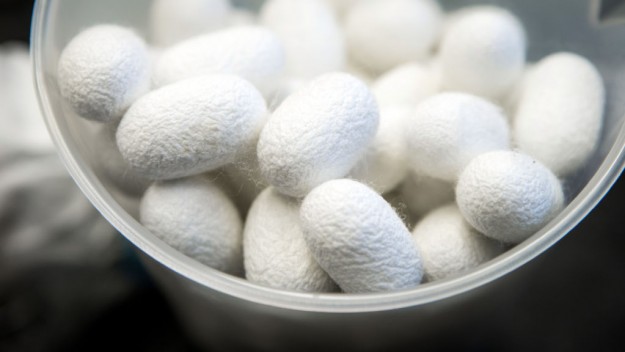
Arthur McKinney purchased four skeins of silk from the Colden Store on this day, 250 years-ago.

The 'silk' described here is believed to be silk thread. Webster defined silk in his 1828 dictionary as:
"The fine soft thread produced by the insect called silk-worm or bombyx. That which we ordinarily call silk is a thread composed of several finer threads which the worm draws from its bowels, like the web of a spider, and with which the silk-worm envelopes itself, forming what is called a cocoon."

Silk cocoons. Image courtesy of geek.com

Webster's alternate definition for 'silk' was the cloth made of silk fibers.

==============================

Search the DayBook

This article is one in a series of a daily accountings of Colden Store transactions. Be sure you read the first installment for an introduction to the store. You should also read this article which appeared in the Journal of the Orange County Historical Society.

===============================

When Colden used the term 'thread' in the DayBook he was referring to linen thread.  For example, 'thread' sold to the store by local artisans was undoubtedly linen.  That happened on two occasions.

The term 'silk' implied a thread as stated by Webster above, but it was never referred to as 'silk thread' as that must have been thought of as being redundant.

The price per skein of 'silk' was much higher than all of the prices for skeins of 'thread.' In other words, silk thread was more valuable than linen thread.

The DayBook made over 200 mentions of silk. Just about all of them referred to silk thread as they were sold by the skein. On one occasion he sold 'silk' by the yard (see notes on silk fabrics below) and on about ten occasions he used 'silk' to describe a finished item, such as a Cravat, a Camblet, a Stocking, or a Handkerchief.

All silk fabrics were referred to by their 'brand' names and did not contain the descriptor of 'silk'.  For example, Persian, Taffity, Crape, Plush, Poplin, Alamode, and Gimp were all fabrics made of silk.

===============================

Search the DayBook